2026 Future of Branch Banking
Jim Marous
March 2026
: DBR 318
24 pages, 15 tables/charts
Download Printable Version of this page
For more than a decade, the industry has predicted the death of the bank branch. It never happened. What is happening now is far more important. The branch is not disappearing. It is being rewritten, and the institutions that understand this shift are already positioning themselves differently from those still operating under legacy assumptions.
The research makes one thing clear. Banking leaders are not backing away from the branch. More than 70% of institutions view branches as mission-critical or very important to long-term growth, and only a small minority plan to reduce their networks.
But this commitment comes with a very different expectation. The branch is no longer being measured by transactions or foot traffic. It is being redefined around advisory engagement, relationship building, and the moments that matter most to customers.
At the same time, customer expectations have moved faster than most branch strategies. Consumers now expect modern environments, seamless technology, and efficient service to work together as a single experience. They are no longer comparing one bank to another. They are comparing every interaction to the best experiences they encounter anywhere. This shift is forcing institutions to rethink not only what happens inside the branch, but how physical and digital channels work together as part of a unified system.
The physical and operational design of branches is evolving to reflect this new role. Smaller footprints, flexible layouts, and technology-enabled staffing models are replacing traditional transaction-heavy formats. Institutions are investing in self-service capabilities, data-driven engagement, and advisory-focused teams, while increasingly relying on partners to accelerate transformation. The branch is becoming less about processing activity and more about creating value.
Across the industry, the gap between what leaders envision and what customers actually experience at the branch level remains significant. Closing that gap will determine which institutions turn their branch networks into a competitive advantage and which simply maintain a legacy channel that no longer delivers on its potential.
Use this report to assess your current strategy, align your organization, and move from intention to execution.
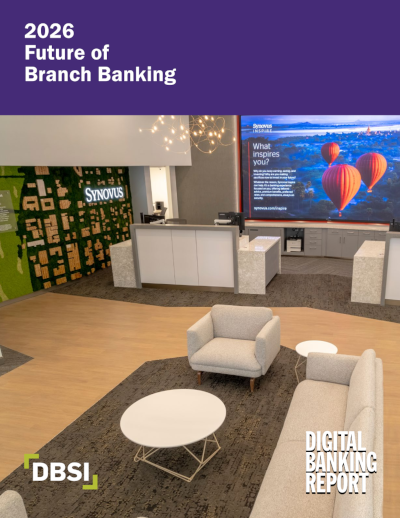
2026 Future of Branch Banking
Advanced Analytics, AI, Analytics, Artificial Intelligence, Bank, Banking, Branches, Credit Union, Customer Experience, Customer Engagement, Digital Banking, Digital Banking Transformation, Digital Lending, Digital Marketing, Digital Transformation, Engagement, Fintech, Innovation, Marketing, Mobile Banking, Payments, Personalization, Technology, Trends