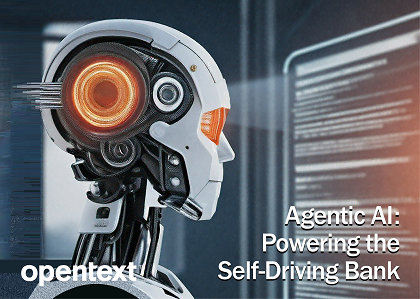
Agentic AI: Powering the Self-Driving Bank
Jim Marous
February 2026
: DBR 316
28 pages, 11 tables/charts
Download Printable Version of this page
Agentic AI is quickly becoming the most consequential shift in banking since the move to digital channels, yet most institutions are still approaching it like every transformation that came before, with enthusiasm at the surface and hesitation beneath it. The result is a growing divide between organizations that are experimenting and those that are actually changing how work gets done.
This report, Agentic AI: Powering the Self-Driving Bank, reveals an industry that is fully engaged but far from ready. Nearly every institution surveyed is doing something with agentic AI, yet only a small fraction have deployed solutions into production. The majority remain stuck in pilots, proof of concepts, or early exploration. This is not a technology problem. It is a leadership, infrastructure, and execution problem.
What makes agentic AI different is not simply its intelligence, but its autonomy. These systems do more than analyze and recommend. They act. They can coordinate across workflows, initiate decisions, and engage customers in real time. That shift moves AI from a support tool to an operating model. It also raises the stakes. The question is no longer whether AI can improve banking, but whether institutions are prepared to redesign how banking actually works.
Drawing on original research and insights from leading global consultancies, this report provides a clear view of where the industry stands today. It examines adoption levels, deployment maturity, strategic priorities, and the barriers preventing scale. It highlights a consistent pattern. Banks are investing heavily in areas with clear guardrails such as fraud, compliance, and cost reduction, while underinvesting in customer experience, revenue growth, and employee enablement where the greatest long-term value exists.
The findings also expose the structural challenges holding institutions back. Governance frameworks are not yet equipped to support autonomous decisioning. Data remains fragmented across legacy systems, limiting the ability to deliver real-time, contextual insights. Many organizations have not even defined how success will be measured. These gaps are not isolated issues. They reinforce one another, creating a ceiling on what agentic AI can achieve.
At the same time, the competitive implications are becoming clearer. Early adopters are already demonstrating measurable gains in speed, consistency, and scalability. Large institutions are deploying agentic capabilities across millions of interactions, shifting from reactive service models to proactive financial engagement. As these advantages compound, the window for catching up continues to narrow.
Perhaps most striking is the disconnect between investment and expectation. While leading firms are committing billions to AI-driven transformation, much of the industry still anticipates only incremental returns. This mindset reflects a broader hesitation to move beyond pilots and commit to enterprise-wide change. It also signals risk. Institutions that underestimate the impact of agentic AI may find themselves outpaced by competitors that move with greater clarity and conviction.
This report is designed to help leaders cut through the noise. It provides a practical framework for understanding where your organization stands, what is required to move forward, and where the greatest opportunities exist. More importantly, it challenges the industry to confront a simple but critical question. Are you building toward a self-driving bank, or are you simply testing the technology that will enable someone else to do it first?
For organizations ready to move beyond experimentation and turn agentic AI into a competitive advantage, this report offers both a reality check and a path forward.
Agentic AI: Powering the Self-Driving Bank
Advanced Analytics, Agentic AI, AI, Analytics, Artificial Intelligence, Bank, Banking, Credit Union, Customer Experience, Customer Engagement, Digital Banking, Digital Banking Transformation, Digital Lending, Digital Marketing, Digital Transformation, Engagement, Fintech, Innovation, Marketing, Mobile Banking, Payments, Personalization, Technology, Trends